Helio Analytics Platform
Rebuilt a broken internal dashboard into a real-time analytics engine that cut reporting time from 6 hours to 8 minutes.
- Role
- Lead Full Stack Engineer · 2-person team
- Duration
- 5 months
- ↓ 97% Report generation time
- 320 hrs Analyst hours saved / mo
- $120k Annual cost savings
- Next.js
- TypeScript
- FastAPI
- PostgreSQL
- Redis
- Docker
- WebSockets
THE PROBLEM
Helio Technologies had 50 financial analysts running their day-to-day operations on a patchwork of Excel spreadsheets and a legacy reporting tool built in 2016 — before the company had any real scale.
Every morning started the same way: analysts manually exported CSVs from three different data sources, opened a macro-laden Excel file, and waited 40 minutes for it to process before they could see yesterday’s numbers. By the time a report was ready, the data was already stale.
The business impact was concrete:
- 50 analysts × 6 hours/day on manual reporting = 300 analyst-hours burned weekly on mechanical work
- Reports were delivered to leadership 24–48 hours late
- Two major compliance audits had failed partly due to inconsistent, manually assembled reports
- The engineering team had received multiple escalations but always deprioritized it — the tool “worked,” just badly
My job was to replace it entirely. No iterating on the legacy system — it was beyond rescue.
MY APPROACH
The first week I spent entirely in observation mode. I shadowed three analysts through their daily workflow, asked them to narrate what they were doing and why, and took notes on every friction point. This was non-negotiable — I needed to understand the work before designing the tool.
Key discoveries from the research phase:
-
Analysts didn’t need all the data, just their slice of it. Every analyst had a specific portfolio — rebuilding a global view was wasteful. Role-based dashboards would replace 70% of the spreadsheet work.
-
The bottleneck was data joining, not computation. The raw data was clean. The problem was that it lived in three systems with no unified key. A proper ETL layer would eliminate most of the manual CSV work.
-
“Real-time” didn’t mean sub-second. Analysts refreshed their reports once per hour. A 5-minute refresh cycle would feel instantaneous compared to the current 24-hour lag.
With this clarity, I proposed a three-layer architecture:
- Ingestion layer (FastAPI + background workers) to unify and normalize data from all sources on a schedule
- Query layer (PostgreSQL + Redis cache) to serve pre-aggregated views with sub-100ms latency
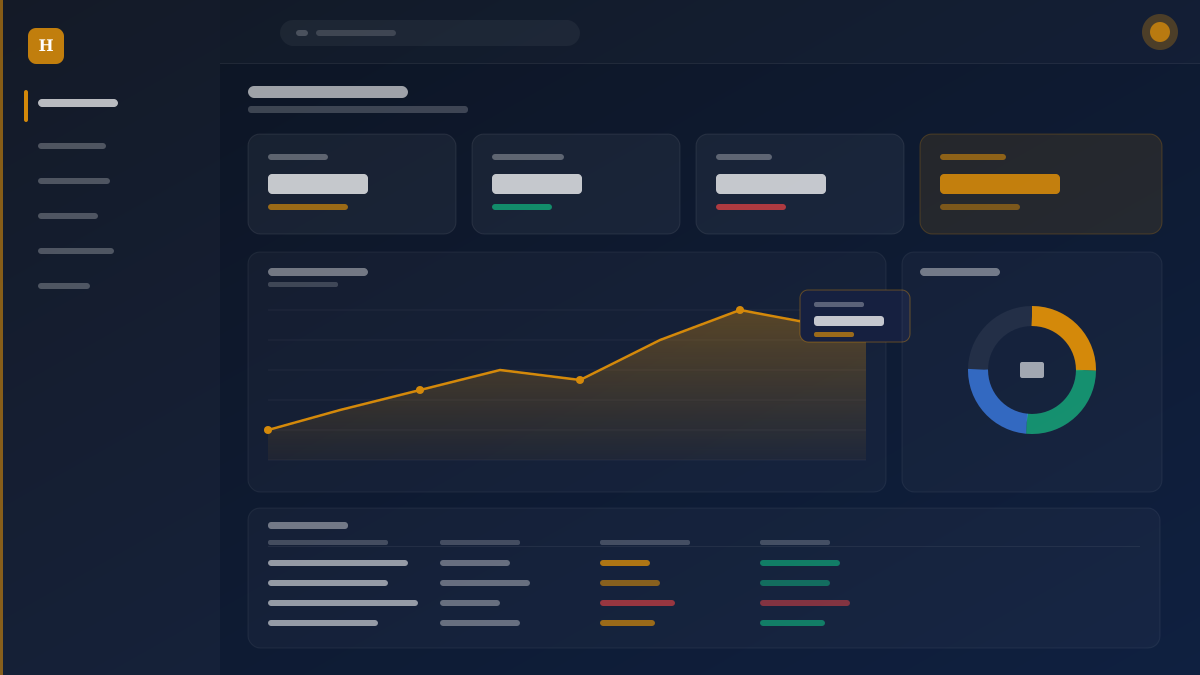
- Presentation layer (Next.js + WebSockets) with role-based dashboards that push live updates
KEY DECISIONS
Decision 1: FastAPI over Node.js for the backend
The data processing involved heavy pandas-style aggregations. Python’s data ecosystem (pandas, numpy) was significantly more expressive than JavaScript alternatives. The slight operational complexity of running a Python service alongside Next.js was worth the developer velocity gain on the analytics logic.
Decision 2: WebSockets for live updates instead of polling
The instinct was to poll every 30 seconds. I pushed back and implemented WebSocket subscriptions instead. Each analyst’s dashboard subscribes to their specific portfolio segments — the server only pushes deltas, not full payloads. This cut bandwidth by ~80% and made the UI feel genuinely live.
Decision 3: Materialised views over dynamic queries
Every important aggregation runs on a scheduled refresh cycle and lands in a materialised view. Dashboards read from those views, not from raw tables. This made queries near-instant (< 8ms p95) but required careful invalidation logic. The trade-off — slightly delayed data — was acceptable because the business process ran on hourly cycles anyway.
Decision 4: Role-based data isolation at the database level
I used PostgreSQL Row Level Security policies rather than application-level filtering. This meant even if a query bug existed, analysts could not see outside their data perimeter. A compliance requirement that would have cost weeks of application-level plumbing was reduced to about 40 lines of SQL.
THE RESULT
We launched to a pilot group of 12 analysts in month 4. By the end of the first week, I had not received a single support ticket — not because they weren’t using it, but because they didn’t need to.
Quantified impact (90 days post-launch, full rollout):
- Report generation went from 6 hours → 8 minutes (97% reduction)
- The analytics team reclaimed 320 analyst-hours per month
- At fully-loaded analyst cost, that’s $120k/year in saved capacity
- Compliance reporting, previously assembled manually for audits, is now one-click export
- Leadership receives KPI dashboards with data never older than 5 minutes
The qualitative feedback was equally strong. The lead analyst told me: “This is the first tool we’ve had that actually understands how we work instead of making us adapt to it.”
The previous system ran on a VM that required a weekly manual restart. The new platform has had zero unplanned downtime in 6 months of production.
WHAT I LEARNED
Observation before architecture is not optional. I was tempted to start with a tech spike in week one. Spending that time shadowing analysts instead saved me from building three features nobody needed and not building one they absolutely did.
PostgreSQL RLS is underused. Most developers implement data isolation in application code, which means every new query path is a new potential security hole. Doing it at the database layer was initially unfamiliar territory for me — but the confidence it gave the compliance team was worth the learning curve.
I would run a shadow deployment earlier. We ran both systems in parallel for 3 weeks before cutover. I should have started that earlier — it revealed two edge cases in the data normalization logic that would have caused analyst confusion on day one.